Blockchains do not talk to each other natively. Ethereum has no idea Bitcoin exists, and vice versa. Yet billions of dollars move between chains every day. How? This guide explains every layer of the cross-chain stack — clearly, without glossing over the parts that actually matter.
The Core Problem: Blockchains Are Islands
Each blockchain is a self-contained settlement layer. A Bitcoin node validates Bitcoin transactions. It has no mechanism to verify what happens on Ethereum. There is no native "send ETH, receive BTC" — the two systems are completely isolated.
Cross-chain infrastructure solves this by introducing trusted or trustless intermediaries that coordinate state across both chains. The key word is coordinate — at some layer, someone or something needs to observe both chains and act as a bridge.
The Three Approaches
1. Lock-and-Mint Bridges
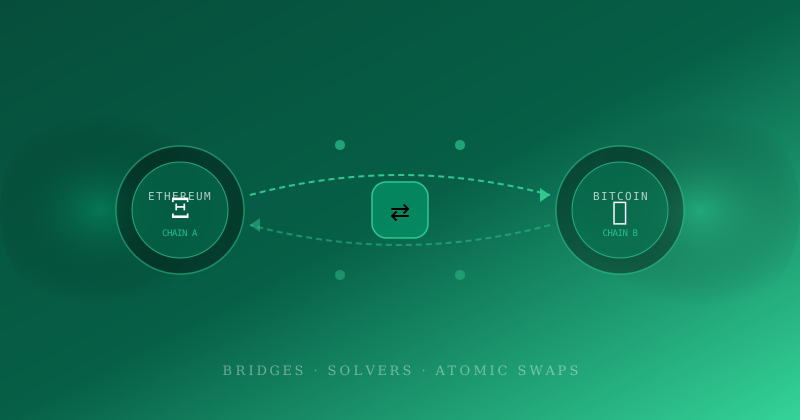
The most common bridge design. You send ETH to a smart contract that locks it. A bridge relayer observes the lock and mints a "wrapped" version of ETH on the destination chain (e.g., wETH on Polygon). When you want to go back, you burn the wrapped token and the bridge unlocks the original.
Risk: The locked assets sit in a smart contract. Bridge hacks are the most devastating in DeFi history — over $2.5 billion lost to bridge exploits between 2021 and 2024. The Ronin bridge hack alone was $625 million.
2. Atomic Swaps
A cryptographic technique using Hash Time-Locked Contracts (HTLCs). Both parties lock funds simultaneously, and the swap either completes for both or reverts for both — atomically. No intermediary holds funds.
Limitation: Both chains need to support the same cryptographic hash function, and the swap requires both parties to be online during the window. This works well for BTC↔LTC but is hard to generalize across all chains.
3. Liquidity Pool Cross-Chain Routing
Modern cross-chain aggregators (and many DEX bridges) use unified liquidity pools. Instead of actually moving your ETH to Bitcoin, a solver network fulfills your order from pre-positioned liquidity on both chains. You send ETH on Ethereum; someone else receives BTC on Bitcoin from a pool they maintain there, and nets out the difference off-chain.
This is the approach NEAR Intents uses — and it is significantly faster and cheaper than lock-and-mint bridges.
What Happens in a GhostUSD Swap
When you enter an amount and select a token pair on GhostUSD, the following happens in parallel:
- Quote aggregation: Multiple protocols (NEAR Intents, HoudiniSwap, RocketX) are queried simultaneously for the best route and rate
- Rate comparison: Quotes are ranked by output amount, estimated time, and privacy level
- Route selection: You pick a route, provide your receiving address, and approve
- Swap initiation: Your selected protocol gets the swap request with your deposit address
- Settlement: You send to the deposit address; the protocol routes and delivers to your receiving address
No intermediary holds your keys at any point. The swap is non-custodial: you send to a protocol-generated address, and the protocol delivers the output.
Why Rates Differ Between Routes
The "best rate" is not always obvious because each protocol charges differently:
- Protocol fee: The swap provider's own margin (0.3–1% typically)
- Liquidity depth: Larger swaps get worse rates on thinner pools (price impact)
- Gas on both chains: Cross-chain swaps incur gas on source and destination chains
- Bridge fee (if applicable): Lock-and-mint bridges charge a separate relay fee
GhostUSD shows you the actual output amount after all fees, not the headline rate — so what you see is what you get.
Fixed Rate vs. Floating Rate
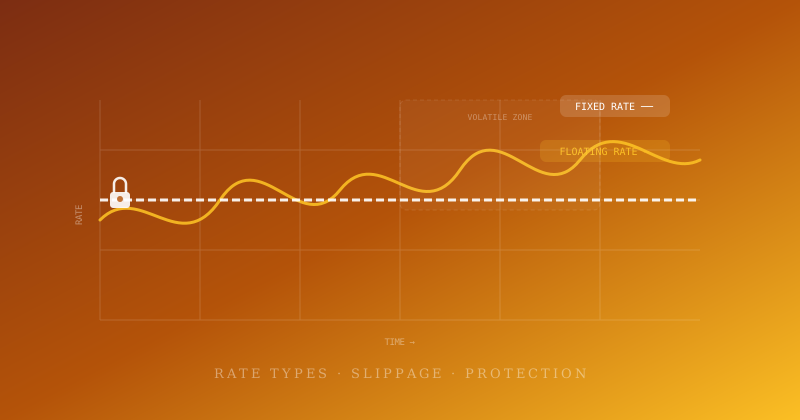
Some protocols offer "fixed rate" swaps — the rate you see is the rate you get, regardless of market movement during execution. Others offer "floating rate" where the final output depends on the market price at settlement time.
- Fixed rate: Better for large amounts where slippage protection matters; slightly worse headline rate
- Floating rate: Better rate in stable markets; output can vary if the market moves
The Safety Checklist
Before initiating any cross-chain swap:
- Always double-check the receiving address — crypto sent to the wrong address is unrecoverable
- Verify the protocol's audit status (GhostUSD only routes through audited protocols)
- Set a refund address in case the swap fails — this should be on the send chain
- Never close the browser mid-swap — wait for the deposit confirmation
- Keep the transaction ID — you can use it to check status at any time
Cross-chain swaps have come a long way. With GhostUSD aggregating the best routes, you get competitive rates, privacy, and safety without having to evaluate each protocol individually.