You enter a swap for 1 ETH to USDC. The quote says you will receive 3,482 USDC. But will you? It depends on whether the swap uses a fixed rate or a floating rate — and the difference can be meaningful.
The Fundamental Difference
When you initiate a swap, there is a gap between the moment you see the quote and the moment your swap actually settles on-chain. Crypto prices move during that window.
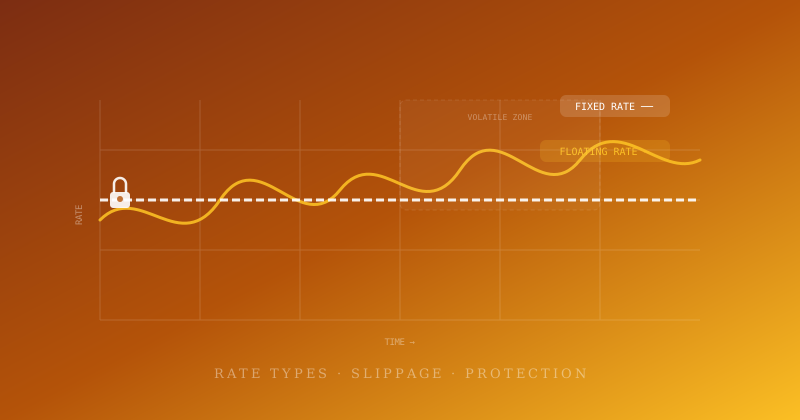
- Fixed rate: The rate is locked at quote time. You receive exactly what the quote shows, regardless of what the market does.
- Floating rate: The rate is set at settlement time. If ETH goes up during your swap, you receive more USDC. If it drops, you receive less.
Why Fixed Rates Cost More
A fixed rate is essentially an options contract. The swap provider is promising you a specific output amount and taking on the market risk between quote and settlement. To compensate for this risk, they charge a small premium — typically 0.3–0.5% more than a floating rate quote.
In a stable market, this premium is pure cost. In a volatile market, it is insurance.
When Fixed Rate Is the Right Choice
Large Amounts
The more you swap, the more absolute dollars a 1% move represents. Swapping $100,000 of ETH when the market moves 2% against you means receiving $2,000 less than expected. For large amounts, the fixed rate premium is usually less than the potential slippage risk.
Volatile Market Conditions
During high volatility — a major news event, a market-wide flush, a token-specific pump — floating rates can deliver very different outputs than the quote. If you need precision, use fixed rate.
Accounting and Tax Purposes
If you need to know the exact output amount for accounting (e.g., converting to stablecoins at a target price for treasury management), fixed rate eliminates the uncertainty.
When Floating Rate Is the Right Choice
Small Amounts in Calm Markets
For smaller swaps in stable conditions, floating rate usually delivers a better headline output — and the market risk is minimal. The 0.3% fixed rate premium costs more than any realistic slippage.
When Speed Matters More Than Precision
Floating rate protocols sometimes settle faster because the protocol does not need to hedge its position. If you need funds quickly and the amount is not critical, floating rate is often faster.
Trending Markets in Your Favor
If you are selling a token that is rising (selling ETH when ETH is pumping), a floating rate swap will deliver more than the locked quote. Though timing the market is always speculative.
How GhostUSD Handles This
GhostUSD shows you quotes from multiple protocols simultaneously, and each quote clearly indicates whether it is fixed or floating rate. The "Fixed rate available" badge on a quote card tells you exactly what you are getting.
The transaction breakdown panel shows you the detailed fee structure — so you can compare the effective rate after all costs, not just the headline number.
The Privacy Angle
There is one more consideration: fixed rate swaps are slightly better for privacy. On-chain analytics software works partly by matching exact amounts across chains. A floating rate swap settles at a precise market price — a very "round" or predictable number that can be easier to match. A fixed rate swap's output is set at quote time and is a more arbitrary number, making amount-matching harder.
This is a minor factor, but it is real.
Quick Decision Framework
- Swapping >$10,000 → Fixed rate
- Swapping during high volatility → Fixed rate
- Need exact amounts for accounting → Fixed rate
- Swapping <$1,000 in calm markets → Floating rate
- Want fastest settlement → Floating rate
GhostUSD shows you both options — you are never forced to choose blindly. Compare the quotes, check the breakdown, and pick what fits.